''I really want to come back here and explore this very strange world'': Τravel impressions from the past mysterious Athos and the Greek countryside by Stephan Micus
OK, so it is the 22nd of September. We are in Exarcheia. The narrator is Stephan Micus and the researcher is Anna Papaioannou. I would like to start with a few things about you. You have studied and played in various manners, traditional instruments from all over the world. You have released more than 20 albums on ECM.
[00:00:00]
25.
25.
Yes.
And two of them are related to Greek music traditions.
Yes. Well, not so much music traditions, but to... They are related to Agion Oros and the experiences I had there. And they have these Greek church language texts. The music is only not very much -so much- inspired by Greek music, but the texts are absolutely original from the church texts prior to the Panagia. And so I think later on, we come to that.
Yes. OK. Maybe we can take it from the first time you visited Greece, what was the occasion?
Yeah. So in 1972, I finished the school and in my class there was a Greek boy. My school was near Munich, in Bavaria. And so the Greek boy had the idea to rent a ruined monastery in Chalkidiki. I think it was on the first finger as far as I remember. So the idea was that all the friends from my class and they would somehow come to Greece and we can spend some time together in this monastery. So that was completely, of course, empty, I mean, it was like ruined, some rooms were still OK. And so in my case, I took a 1950 BMW 500 cubic motorbike with my girlfriend on the back, and a guitar on the back and rucksack and luggage. And we went through from Munich to Austria and Hungary and Romania and Bulgaria and to this monastery in Chalkidiki, you know. It was, of course, still communist time, so that was quite an adventure, also, to pass through all these three communist countries. And... But we finally made it and we... So I'm not speaking now about the trip, no? Because you want to hear only about Greece.
Yes. But if it's something that you just remembered and you think it's nice to share, you can also do that, I mean, there is no ban.
Yeah, I see. OK. So we arrived in the monastery and it was really nice and at one point we went to Ouranoupolis and there was a boat which I think still exists, which takes tourists along the coast of Agion Oros. But these people, they don't have a permit to enter, and they can just see the monasteries from the ship. So we took this trip and I was really fascinated. And it was like looking at a magic world, very mysterious, and, of course, I was only 19 at the time. And so I thought: ''Οh, one day I really want to come back here and explore this very strange world and learn more about it, and so''. And, well, after... Yeah... So after we went... I think I left the motorbike in that, in Chalkidiki and we traveled to Athens. I saw the Acropolis and all that. And then we took a boat to Crete and we were walking this Samaria gorge. In that time, there was no hotel. In the end, I mean, you walk the gorge and then you reach the beach. And in that time, there was only a small hut. I mention, maybe now there are many hotels or... And the only way that you could return to the normal world in a way, was with a small boat which came... So we slept in the night at the beach with sleeping bags and the next morning there came a small boat and it took us to the the next village. So that was very nice experience and... Well. So then we went back and returned with the motorbike through Yugoslavia. In that time there was still, some parts of the road in Montenegro, there was no asphalt. It was really an adventure also, but we returned safely. And so that was my first trip, an impression of Greece. And, in the next years, maybe 10 years, I was traveling a lot. First of all, we traveled overland to India because I wanted to study the sitar. And after I returned to Germany, I went to United States and then to Japan to study the Shakuhachi Bamboo Flute. And I returned to India to continue with the study of sitar and through Indonesia and Burma, all these places. I started to make my first CDs. Well, at the time there was only LPs of course. Using so many different instruments, which I learned and collected on all these trips. Yeah. It was a really nice moment when I came back home and all these instruments for the first time, they were with me in the same room, so to speak, and I started to compose some music with them and to combine... This is the way of work, which I still continue until now. To combine instruments from different cultures and in many of my compositions, these instruments, they play together for the first time. For example, let's say there's a composition with a Japanese flute, a xylophone from Bali and a Zither, which is a string instrument from Bavaria, Germany. So these 3 instruments, of course, never played together before. In almost all my compositions, there are instruments which have never sounded together before and this is an idea which fascinates me a lot. So I started to make my first, CDs... No, sorry, not CDs! LPs, and... So that's how I passed the next 10 years or 11. Because I came back to Greece, maybe I think it must have been around 1983. No, sorry. '84, maybe '85, because I was invited to play a concert and actually in Lycabettus, that was the first time. And my friend, Nikos Valkanos, he came to the airport with Ross Daily and that was when I met Ross the first time. I think Nikos brought him, also, because his English was still very poor and he... So Ross was able to translate and... Yeah, it was fantastic to play there and I think there was in the same moment a concert in Thessaloniki. [00:10:00] I think that was in a cinema where they also used to play concerts. I don't remember the name really. I think there, in the name, there was the word 2000, but I'm not sure. And there was also a concert -I don't know if it was exactly the same time- but in the Venetian Church of Heraklion, which was also beautiful. Αnd so for me, it was very nice the way the Greek people received my music, because they understood much better my music, than in central or northern Europe, because Greece was always a place which was on the border of East and West and my music, also, has the same topic. It has the same theme. It's a mixture of Western and Eastern cultures. So, it's somehow logical that Greek people... For them it's easier to access this music than other European countries. So that for me was very nice experience because until then I played only in other European countries which for them it was maybe more difficult to enter in this world. So, in this time, when I was in Athens, I saw, I spoke with Nikos and I said to him: ''You know, I really want to go back to Athos, because I remembered this boat trip, which was more than 10 years ago, and I never forget about this place''. And then he said: ''OK, there is a young monk, he really likes your music''. And he would be very helpful if I go there and so... So they helped me to get this permit and I went to Karyes, where my friend Andreas, he lived in a skiti, not in a monastery, but in a skiti very near to Karyes and we became very good friends. He was a very nice man and we are still friends. I just saw him, after so many years. Must be almost 40 years. So, the first impression on Agion Oros, it was really nice to arrive in that time. You arrived in the harbor... I forgot the name of the harbor. Yeah. I forgot the name of the harbor. There's a small harbor where all the boats arrive and there was a very old bus, which at that time was one of the very few vehicles in Agion Oros. Μaybe there were 1 or 2 more Jeeps for the principal. I don't know how. For some of the Abbots of the monastery, but I think there was only 3 or 4 cars in the whole Agion Oros. And one of them was this really funny old bus, which made the trip from the port to Karyes and in Karyes, everybody went out. And from there, you could only travel by foot. So in my case, Andreas waited for me and we went to his skiti. So, the first impression was not a monastery, but this house where he was with his jeronta and two other monks. So I got to know how is this system with this skiti and it was really like another world, you know. It was so fascinating to see all these beautiful old buildings. Karyes, it's also a very strange place, only with monks and some construction workers or other workers who have a job in any of the monasteries or houses. And then they told me to... I think that was Stavronikita, which was the monastery where the jeronta of Andreas, he was there, before he left the monastery and was the master of this skiti. So that was my first monastery and it was really fascinating. So the custom in Agion Oros is that you can go to any monastery... Well, at that time. I think now you have to make reservations and all, everything is more difficult. But in that time, you could go to any monastery and then stay one night and the next day you had to leave this place and go to another monastery. So, for the first time, I saw this place where they eat, all together. And it was very strange because there was one monk, reciting the Bible, and we had to eat very quickly, because when he finished reading, we had to get up and go. If we finished our food or not, that didn't matter, so I mean, they had this whole idea that the body should not have too many pleasures. Of course, they were forbidden to have contact with women and all this food it was not there to really enjoy in peace, you know, but you had to eat very quickly. So that was very strange. And then they showed me the place to sleep and, of course, it was very beautiful. The architecture of these monasteries, it's each one, it's like unique and absolutely fantastic. So that I don't remember exactly. The next day I went to another monastery and I enjoyed it very much. The walks, because you walked on 1.000 year old paths. This monopati and many of them, they had a stone floor and they were really very well kept at that time and through forests, and many time you had views on the sea or on the mountain. I mean, there's this very high mountain, Athos, in itself and, yeah. So that was a very nice contrast. So the nights you spent in these ancient monasteries in... Yeah, of course I forgot to tell that the they have a service in the night. So I think, it depends, I think on the monastery, on the season or... I don't know exactly how this works, but mostly they started the service maybe around 2 o'clock or 3 and it lasted usually until the sunrise. So, they woke you up with this strange wooden instrument. I forgot the name of that, but it's it's like a wooden pole and they hit it and it's really very strong sound. So, you wake up and then if you like, you can go in the church and have participate in the service. And that was for me, of course, also a great experience. I've never seen anything like it! I was educated as a Protestant Lutheran in Germany and I never had much interest in these religious things. Because, especially the Protestant churches, they are very empty, in a way, boring and there are no statues. Of course they don't pray to Panagia, the Virgin Mary. They don't pray at all. There are no hardly any statues or images. So, to come in this Greek Orthodox Church in the Stavronikita, which was the first impression, it was really very interesting and beautiful because... [00:20:00]And especially, of course, in the night. And they had only candle light or oil lamps. And there was this golden icons, which I have never seen anything like this. And there were different kind of lights and the monks, they were all the time moving, you know? It was like a dance almost. So, they were moving from one icon to another, they bowed, and then came one man with incense and it was like a whole performance in a way, you know. Like a very beautiful dance, I would say, it was. And of course, some monk who came in with a book and he was reading something and then he closed the book again and another one came and they were singing. So there were so many things going on and in this beautiful candle oil lamp light, it was really very mysterious and very impressive. I was very impressed from this! And yes. So this was, the one aspect in the night and in the daytime, it was a completely different world. You were out in the nature, which at that time was, of course, the best preserved Mediterranean landscape of all the Mediterranean, because nobody since 1.000 years, nobody could go there except the monks. There was not a single hotel, not a single restaurant, no big roads. The only road was from the port to Karyes. And everything else was like...
Wild.
Like... Yeah. Pure and natural. And, I mean, unique, because all the rest of Mediterranean world has been open to tourism. Many hotels, all the beaches, and spoiled in a way, you know? That was the purest place you can find. So in the daytime, you were walking in this very beautiful Mediterranean landscape, which was like almost Pagan, like it was the world of Pan. And it was a very big contrast to the Christian monasteries, in the night and in the day walking in this landscape. So this inspired me later on in these first years then, because of the friendship with Andreas, and because I was so fascinated from this world. I returned many times and I had the privilege to have a permit and I could stay longer as... I think it was 3 or 4 days they gave you normally, but because I have had this friendship with Andreas and he's jeronta, I could stay longer and... So I visited all the monasteries and many of them several times and I was walking all the paths connecting the monasteries. And one summer, I remember, I went with Andreas to the top of the Athos Mountain. It was August and we came in a snowstorm in August on the top. And there there was a little house, like a shelter, where we were sleeping and it was so cold. We had to make fire in the middle of August and, of course, that was also a great experience because from the top, you have such an amazing view, you know, on the whole peninsula and you see the sea and you see this island. I don't remember what... Thraki is it? No. This one island to the east of Agion Oros, you could see that also and yeah... So I had many visits of Agion Oros in the next years and also always or mostly I had also concerts in many places which always was very beautiful. And then I had the wish to create some music which reflected this time in Agion Oros, and I choose a special form and construction of the music. So this first album which was dedicated to that world, it's called Athos. So the pieces, the small parts of the whole composition, they had a very consciously constructed structure. The first piece was called On the Way. And then came the next piece, was the First Night and the First Day, the Second Night, the Second Day, the Third Night, the Third Day, and the last piece was called On The Way Back. So the first piece I think it's a Bavarian zither, with an instrument from Xinjiang. It's in West China. It's an instrument not from this Han Chinese, but the Uyghur people which are like... They are Muslim minority, which live in the western China. Their race it's like Central Asia, it's not Han Chinese, and they have very beautiful instruments. So this Satar, it's one of them. It's a very long necked kind of lute, but they played with an arc, with a... Sorry, with a bow! So that is the first piece On The Way. It's like an introduction, and then comes... I don't know if comes first the First Day or the First Night, doesn't matter. So all these pieces for the night which, as I said before, you spent the nights in the monasteries. So in this, for these, for the 3 pieces which were the first second and third night, I choose just voices and I had a text. With my friend Vassilis Chatzivassiliou... He's from Thessaloniki and he used to be a Greek language teacher and his very big passion is Greek language and he's every day reading poems and... So he helped me to find some beautiful prayers to the Virgin Mary. And so I choose these texts with him. And he also taught me to have a good pronunciation of these texts. Apparently I didn't do so bad, but he was a very strict teacher. So... Yeah. I made coral pieces because in Byzantine music you have usually in the churches only voices. You don't have organ or any other instruments. So I followed this system and I created some choral pieces, all with my own voice. With multi-track recording systems you can do that. You can start with one voice and then you hear this first voice in the headphones and you sing the next voice and so on, until you have your own choir. And I didn't want to use the normal Byzantine scale for these songs, but I choose different scales which are used, for example, from an Indian raga and one of the pieces it uses the scale of the Northern Epirus music. [00:30:00]So I wanted to create other feelings, other sounds than the Byzantine songs, because there are already so many and of course they're fantastic. It didn't make sense to me to repeat this. So that is the 3 pieces for the nights. And for the day, because before I said, if you walk in the nature of Agion Oros, it's like the kingdom of Pan, who is the god of nature. So Pan is playing flute. For this reason, I choose for all the day pieces, I choose different flutes. This construction, it seemed to me very satisfying and the last piece which I called on the way back, it's speaks about when you return from Agion Oros, in the normal world. So, in that piece I used the same instruments like the first piece, but in the second part of that piece, there is added another choir. So that is kind of a symbol that you travel back but you have in your head this memory from these churches and from the singing. So, I was very satisfied with this album and also this whole, the structure that I found to which I could give it. And there are some beautiful photos in the CD from a book, an Austrian photographer made on Agion Oros. So that CD is still available and hopefully some people listen to it. So that was the first CD that I made for the Greek, with the prayers, with the Greek language. So, some years passed, in that years, I still came a lot to Greece and... Ah yeah, I can tell about there. There is one area which right now I came back the fourth time which I really like. I think it's one of the most beautiful areas in the world, and this is Zagori in Epirus. So in 1990 my first daughter was born, and all my life I was driving motorbikes. And when my daughter was... It was clear that soon she will be born. I thought... Because I really don't like cars. I feel like a sardine in a metal box. So I thought: ''Well, what can I do to still drive motorbike and have the baby there with the mother?''. So I found this sidecars, which not... Many people don't even know what is this. So this is a motorbike which has a little... Well, they call it sidecar, on the side, and in that, there can sit the mother and the children. So this is after the war in Germany when people didn't have money to buy a car. The father used to have a motorbike in the week days. So he went to work with this and he took off the sidecar, he just went with the motorbike and on the weekend, when the family would go to an excursion, there he put the sidecar and the wife and the children, they were sitting in the sidecar. So I bought one of those. And when my daughter was, I think, 7 months old, we drove all the way from Munich to Italy to -I think- Brindisi, and we took the boat to Corfu and then from there we went to Zagori. And when we were in Zagori, all of a sudden, there came another motorbike with sidecar, which of course it's very rare and I think especially in Greece, it's very, very rare to see the sidecar. So we said: ''Hello -and- how are you?''. And he was looking at my sidecar. I was looking at his one. It was a Russian Ural and I had a BMW and so we became friends and we are still friends. His name is Kostas, he's a very good photographer and I was so lucky because this man is probably the person who knows Zagori best. He made very nice, at that time, postcards. Nowadays, of course, people hardly write postcards anymore, but... And he made a book and he was also a guide for certain people and he's very enthusiastic about this national park because there are always problems that people don't respect the laws there and he's kind of fighting with these environmental groups and also he likes very much music. So we became friends and we were walking everywhere in this place. And propably there are not many foreigners who know that area like me thanks to him. And I think, especially the river Voidomatis, it is unique in the whole world. All this area, really. I have traveled very, very much. I've seen so many places in all the world, but this it's really a treasure. Several times I was in the summer, in August, when they have all this panigyri, and I was very interested in the clarinet playing. And there is a special zone which reaches into what is now Albania, which many Greek people, they call it Northern Epirus, which is called Pogonia, and they have a very interesting music, which is based on a 5 tone scale, which is very rare in Europe. In Asia, there are many places who use 5 tone scales, but in Europe... Well, there's Irish music, Celtic music. They use 5 tone scale but I'm not really aware of any other region. So, there was a time when I traveled in Epirus and I followed these clarinet players. Especially, I like one man, his name is Napoleon Damos, and there's another, Grigori Kapsalis. So I had to contact with these two musicians and they told me where they will play, in which village, and I was driving there with this sidecar motorbike and listened to their performances. And also, the sister of my friend Kostas, Georgia, she taught me some of the dances. This was very important for me because until then, I never really was so interested in dancing. When I was very young in the school, I used to play in a rock group so we used to play and the people were dancing but the musicians usually don't even have a chance much to dance. But anyway, never really so much interested me. But when I heard this music of Zagori, and I saw this circular dances, that really fascinated me. And also they have these really strange rhythms, 5 beats, 7 beats, 10 beats. And that also was new for me because then, in Central European music, we usually have only 3 beats and 4 beats. So that was completely also a new world of rhythms, and to learn the dances, it helped me a lot to... Then later on, in many compositions, I used this kind of rhythms and to be able to dance them, it helped me a lot to get these completely new rhythms for me into my body. It's a different thing if you just listen something or if, for many nights, the whole night, you are able to dance on these rhythms. So that was great. [00:40:00]And, yeah, I listened many many hours and nights to this clarinet music and that was a great inspiration. Also, at another time, I went to Naxos to learn about the island music. Also, my friend Nikos Valkanos, he introduced me to a very traditional, very nice violin player in -I think- a quite famous village of Apiranthos. And we stayed there for some weeks and I listened to this island music. That was another important musical experience in Greece. And so these years passed with all thses. I had made the Athos album and to work with the Greek language, it was for me very nice experience. I like very much the Greek language because it is... With the experience in the Athos album, I was very happy to work with the Greek language. I think the Greek language is very special and very musical language because in most other languages there is a certain rule how to give the accent to the words. For example, let's say in German, let's say a two syllable word. For example, Gabel or Brücke or Hafen. All the words with two syllables, we give the accent on the first syllable. And if we have three syllables, there's also a rule and it will always be on that. I don't know now, first or second or third, but it's always the same. But in Greek, you never know! If you have a two syllable word, the accent can be on the first syllable or on the second. If you have a three syllable word, the accent can be on the first, on the second, on the third. So, this makes for a very interesting rhythm, you know? So the Greek language is really special and it's very interesting to put music to it. So, after some years, I thought: ''Oh, that work was so nice with the Greek language, I want to make one more album''. Using, yeah, using Greek language and I was also thinking about maybe using some poet. But in the end, I like these prayers to the Virgin Mary because in Athos, also, Athos is considered to be the kingdom of Panagia. All the monks, they say this land belongs to Panagia. And these prayers that I choose, they were dedicated to Panagia. Also I think that in our time, most cultures, they are very male dominated. And this doesn't really seem very nice because I have a lot of respect for women, and it was always very important for me the relationship with women. And so I like these prayers to the Virgin Mary because if you're not Christian or if you're not religious, these prayers, could be also love poems to a woman, because the monks of course, they had no contact with women. So all this energy which the male have, to dedicate to the female energy, it was channeled into prayers of the only female which they were allowed to have contact with, was the Panagia. So these are very beautiful texts, very poetic and so we choose these prayers, which all were dedicated to Panagia, and so I called the album Panagia. Also this album, it has a very constructed structure in the sense that I also combine the pieces, like one, like the same almost, like in Athos, that I take a choral piece with the Greek words, the prayers to Mary and then, I put instrumental piece and then again a choral piece, an instrumental and so forth. But this time for the instrumental pieces, I didn't take the flutes, which were a symbol for the Pan and the nature in Agion Oros, but I took bowed instruments. So that was the second CD, which was dedicated to Greece and to Agion Oros, to Panagia and all this. And... Well that, for the moment, I think... So you still have some questions.
The first question is related to the last words you said. These two albums form a sort of dialog? You see yourself experiencing Greece with different eyes and ears between these years that these albums were made?
Well, of course there has been a great change in all the world, not only in Greece. Mostly to the worse, of course. Everywhere. More and more hotels have been built, more and more tourists come, more and more beaches have been destroyed by putting hotels very near, the forests have been cut down in many places or by fire. Especially in Agion Oros there was, in my opinion, a very negative development. The monasteries have received a lot of money from the European Union, and they used this money to systematically destroy this paradise which it was before and they built horrible roads on the mountains to... Basically, I think, to take out the wood, to cut down the trees and by building these roads, they destroyed the very old amazing monopati. Because these roads, they cut through the monopati and you can't even use them anymore, because there are many parts where they are completely cut and you cannot... You would have to jump 3 or 4 meters or whatever. This was done with extreme senselessness, stupidity and disrespect for the tradition that was there since... So in the last 30 years in Agion Oros, it has changed a hundred times more than in the last 1.000. And this beautiful custom, which they had, that you were walking from one monastery to the other, which gave the pilgrims also a chance to move their bodies, not only to sit down in the church or eat in the monastery and be sitting all the time, but they had to move in this beautiful nature and that was at least I think, as important as to participate in the service in the night, at these moments, in the daytime, with this unique nature. It was for my feeling, equally important and they destroyed this. Everybody. There's nobody walking anymore, they all use minibuses on these roads which are, for most of them, at least, when I saw it last, most of them had no asphalt. So when the car is driving, it creates an incredible amount of dust. If there are some people still walking on these roads, they are continuously molested by first the noise, the fumes from the cars and most of all, the dust that it creates. So it is really depressing and sad to see all this. [00:50:00]The monasteries have become very rich there. Each monastery outside there are parked I don't know how many jeeps, all brand new. I mean, the worst example is the Russian monastery which used to be the poorest, because in communist times, of course, the Russian communist government, they didn't care at all about this. The worse the better for them. And I remember it, I was there several times, in that time, there was only 5-6 monks. They had the worst food on the whole Mount Athos, they were really poor, the whole place was going into ruins which it's the biggest monastery, which I think in the time of the Tsar, it had several thousands of monks. So there are these huge buildings, they all have ruined and they restored them which is good, of course. But there with all this money many things changed also, which I think it's not very creative and very...
Complementary.
Yeah, complementary to the idea of being a monk. They, all the monks, they have mobile phones, they are standing there and making calls, or looking in the internet. And yeah, as I said, nobody's walking anymore. They are driving around with these jeeps and it has become...The last time I was there, which is already at least 10 years, I said: ''OK, I will never come here again'', because the beauty has been destroyed, the spirit has been destroyed. In the first years when I was there, if you were walking in the forest, you didn't know where is the monastery. At some point you were hearing some bells and you knew: ''Ah, I have to go there and...'', but in the last time, you didn't hear bells. You heard these building construction machines, huge cranes and so, when you heard this noise, you knew, OK, there's the monastery and…
ΟK. So, your first look of Agion Oros was from a boat, and you were very fascinated from this boat trip. Can you elaborate on what you saw? I haven't done this trip. I know females can also do it, but-
Yes.
With your eyes on '72.
Well, it was simply... I mean, first of all, you saw the nature. I mean, we were coming from the other fingers of Chalkidiki, which even in '72, there was some tourism, and I mean, normal life with cars and roads and hotels, restaurants, villages. And then all of a sudden, you saw this virgin nature and only trees and beaches and without anybody. And of course you saw the Mount Athos, and most of all, you saw these amazing buildings. Such a thing I never saw before. I mean... And yeah, it was so different from normal world that anybody with a little bit sensitivity must be very fascinated.
OK. You spoke for Andreas, who was also your first link to Agion Oros. Maybe you can say a few things about your relationship and how it developed. Andreas was a fan of yours, correct?
Well, yeah. Well, he liked, apparently, my music. He knew it. I don't know if he, when he came across it, if it was before he was a monk or when he was already there. And, as I said, when I told to Nikos that I would like to go there and somehow Nikos found this monk, I don't know how, so he knew that this young man, he likes my music and he was offering to help me and also that I can stay in the skiti and so on. And yeah, it was very... Of course, for me, it was very good luck and beautiful to have him as a companion because on many walks he would come with me and of course you are received in another way, especially as a foreigner in the monasteries, when you come in the company of a monk. So, I remember very well there was the one monastery near Karyes, I'd forgotten the name. Ah, yeah, Iviron, yeah, Iviron! It used to be a Georgian monastery, and so because Andreas was with me, they opened the treasure room and there was a very old Georgian score of singing, with paintings in it and many other things. And of course, they would never show this to me if I was alone. So we had this really nice relationship and actually, he was allowed to visit me in Germany when I was in that time, I was still living in Germany. He was coming to Bavaria and I remember he... In Bavaria, of course, we don't have the sea, but we have many lakes, and he was very afraid to swim with me because he was not used and he thought: ''Oh this water is very dark. I don't know what is there''. Yeah. And then something very strange happened that I had a concert in Athens, and after the concert, Andreas came backstage and he said: ''Hello'' and I looked at him and he had cut his beard, his hair, and he was in a normal dress. And I said: ''What happened?'', yeah, ''I left Agion Oros'', ''Why?'', ''I fell in love with a woman''. So it's a very funny story. They sent him to Athens to buy a Volkswagen bus. And he came to Athens. And for some reason, he had to go, or he wanted to go, also to the theater and there he met his future wife and they got married, and they're still, I visited him some days ago, they are very happy still. After 29 years, they have two adult children and... But for him, it was very difficult because he had made these vows to be a monk and his teacher, his jeronta, he was very attached to him and he was very angry and actually took him 20 years to forgive him which is not very Christian way, in my opinion, but...
I agree...
Anyway, Andreas, I think he made the right decision and he has a very happy marriage and that's fantastic.
Your interactions with the other monks? You mentioned some things that they were reading and you had to eat quickly. Maybe some rules or some strange interactions the first time you went there.
Well. Sometimes it was strange that in some monasteries, especially when I was alone, never when Andreas was with me, this never happened, but when I was alone in some monasteries, they wouldn't even let me in the church at all or only in the entrance room. And they wouldn't let me come into the main room because I was not Orthodox. And this seemed at times a little bit strange because, I mean, I was there with a lot of respect and... Yeah. Nothing more to say about it. It's their way and OK, I said OK. If you think that's the way, that's it then. [01:00:00]But, maybe not so exactly nice. Yeah.
Last question. You spoke a lot for Agion Oros and Zagori, but you also mentioned some other places in Greece that you visited, Naxos and Crete. I'm wondering if you remember any special moments or panigyria in other places of Greece besides these two that...
No, I don't remember any panigyri in other places. One thing, it was a great experience. I had a concert in Lebanon and I used that time to visit also Syria. And I traveled in Syria and I was in a small village and there was a panigyri, or maybe it was just a marriage, I don't know. Anyway, they were having a feast with music and they were dancing exactly in the same way, in a circle and even, in Zagori, also they have this custom, between the first and the second dancer, they have a handkerchief. And also there. So I was really astonished. And we can see that this way of circular dance, it's not only in Greece, but it's very ancient thing. And it was for me very interesting to see that it's also in other country of this area they do this.
OK. Thank you very much!
You're welcome!
Photos
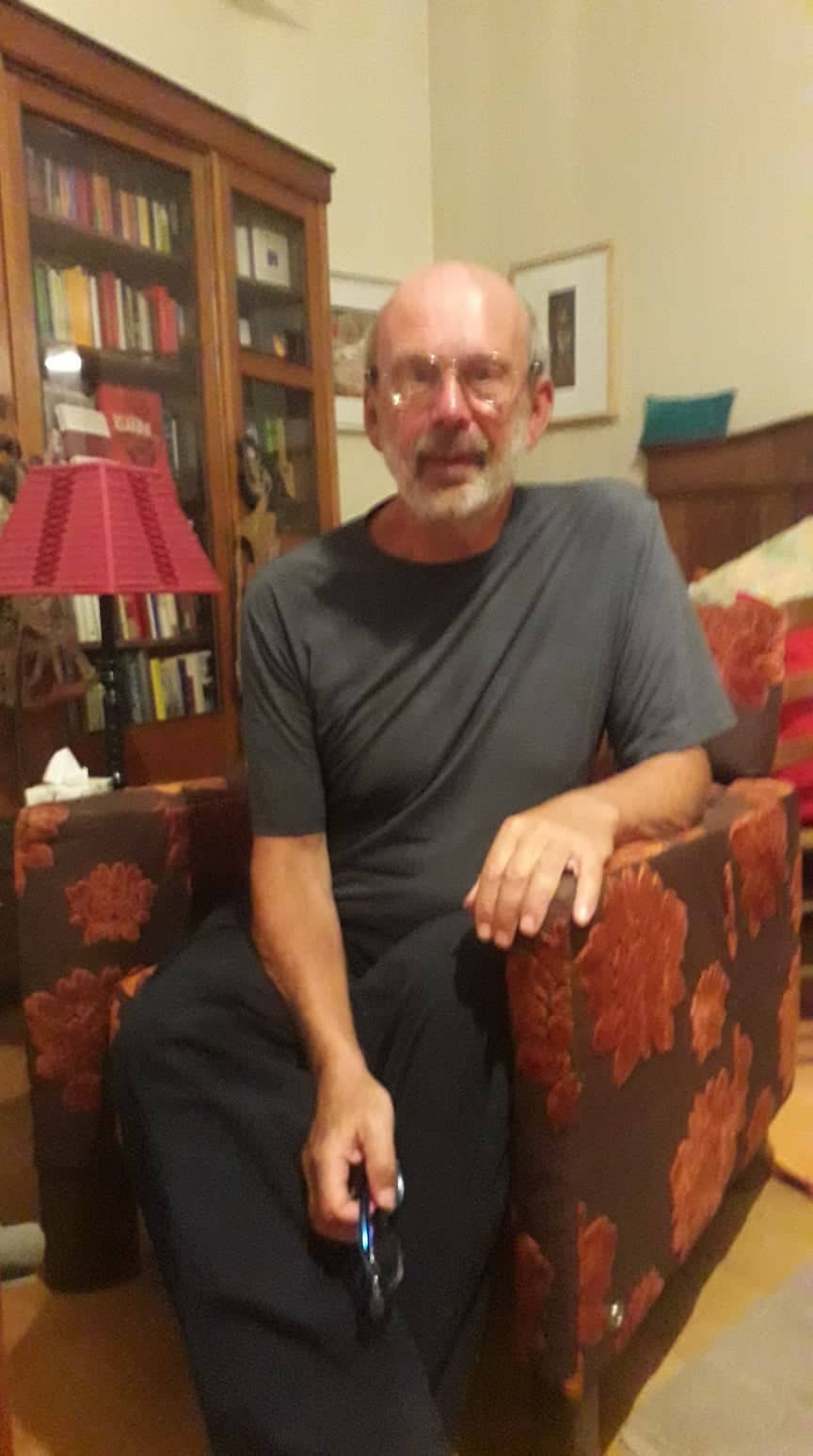
Stephan Micus
Ο αφηγητής στο σπίτι του.
Part of the interview has been removed to facilitate its flow.
Summary
Ο Stephan Micus, μουσικός, συνθέτης, πολυοργανίστας και ερευνητής μουσικών παραδόσεων, διατηρεί έναν ισχυρό δεσμό με την Ελλάδα ο οποίος ανάγεται σε βάθος 50 χρόνων. Μοιράζεται τις εντυπώσεις του από τα πρώτα ταξίδια στη χώρα που συνδέονται άρρηκτα με την επίσκεψη των μοναστηριών του Αγίου Όρους και της τριγύρω περιοχής. Τα όσα είδε κι έζησε εκεί τον εντυπωσίασαν τόσο που εμπνεύστηκε από αυτά με αποκορύφωμα τη δημιουργία των προσωπικών μουσικών άλμπουμ «Athos» και «Panagia». Περιδιαβαίνει σε διάφορα μέρη της Ελλάδας που τον γοήτευσαν, ενώ δεν παραλείπει να αναφερθεί και στις προσωπικές φιλίες που κρατά εδώ και χρόνια με ανθρώπους του τόπου.
Narrators
Stephan Micus
Field Reporters
Άννα Παπαϊωάννου
Tags
Interview Date
21/09/2022
Duration
61'
Part of the interview has been removed to facilitate its flow.
Summary
Ο Stephan Micus, μουσικός, συνθέτης, πολυοργανίστας και ερευνητής μουσικών παραδόσεων, διατηρεί έναν ισχυρό δεσμό με την Ελλάδα ο οποίος ανάγεται σε βάθος 50 χρόνων. Μοιράζεται τις εντυπώσεις του από τα πρώτα ταξίδια στη χώρα που συνδέονται άρρηκτα με την επίσκεψη των μοναστηριών του Αγίου Όρους και της τριγύρω περιοχής. Τα όσα είδε κι έζησε εκεί τον εντυπωσίασαν τόσο που εμπνεύστηκε από αυτά με αποκορύφωμα τη δημιουργία των προσωπικών μουσικών άλμπουμ «Athos» και «Panagia». Περιδιαβαίνει σε διάφορα μέρη της Ελλάδας που τον γοήτευσαν, ενώ δεν παραλείπει να αναφερθεί και στις προσωπικές φιλίες που κρατά εδώ και χρόνια με ανθρώπους του τόπου.
Narrators
Stephan Micus
Field Reporters
Άννα Παπαϊωάννου
Tags
Interview Date
21/09/2022
Duration
61'