Ζητούνται παιδιά από την Ελλάδα: Οι διεθνείς υιοθεσίες στα χρόνια του Ψυχρού Πολέμου
Segment 1
How the adoptions started
00:00:00 - 00:08:36
Partial Transcript
So, what prompted you to start looking for the mass adoption of Greek children in the wake of the Greek Civil War? Well, thank you for as… of the family to the assassination, but they've also kind of been humiliated in that their capacity to raise children has been diminished.
Lead to transcriptSegment 2
Forced consent and the Act of Adoption
00:08:36 - 00:15:34
Partial Transcript
So, we're talking about the ‘50s and the ‘60s. Let's talk about some cases. Let's say, what's a common case of an orphaned or not orphaned …ere. It is so prominent in these documents that the money is ultimately the most persuasive argument being used to justify these adoptions.
Lead to transcriptSegment 3
The family reunification and the closure
00:15:34 - 00:23:46
Partial Transcript
Let me tell you… I don't know if we can speak for a particular case. Let’s state an example in order to understand. Maybe a case of forced c… it's hugely emotional. And it fulfills them. It fulfills them and it puts them… It puts something right, it fills the hole in their heart.
Lead to transcriptSegment 4
The obstacles to finding the missing relatives
00:23:46 - 00:30:02
Partial Transcript
Now, your research… Aren't there enormous obstacles in order to find these children? Yes, yes. What’s the procedure? The biggest difficul…to finally end up in the US? To kind of reconstruct that trajectory is very important to them. It's almost as if you came out of nowhere.
Lead to transcriptSegment 5
The rensponsibility of Greece
00:30:02 - 00:38:00
Partial Transcript
Now, were there any monitoring… Once upon they give up the child, was there any monitoring of the family? Has Greece ever tried to contact …ack, so that they can finally, if they're still alive, come out of their shell and have this history of knowledge. That would be my dream.
Lead to transcriptSegment 6
Stories of adoptees and the book
00:38:00 - 00:56:03
Partial Transcript
Have they been cases in which we didn't arrive on time, let's say? Yes, yes. An adoptee friend whose… I found the address of her mother j…hen, how does the child feel about having been given up for the sake of three refrigerators and a washing machine? I find it very painful.
Lead to transcriptSegment 7
Who is Gonda Van Steen?
00:56:03 - 01:02:05
Partial Transcript
Finally, tell us a little bit about you. How did you end up... We all know, how did you end up of searching like that, but how did you end …s with it. So, on that note, I wanna leave that message. Thank you very much for your interview. Thank you, thank you. Εγώ σας ευχαριστώ.
Lead to transcript[00:00:00]So, what prompted you to start looking for the mass adoption of Greek children in the wake of the Greek Civil War?
Well, thank you for asking. This project came as a surprise to me, as well. I was doing other things, until one day I received an email from the grandson of Ilias Argiriadis, and his mother and his aunt were the two children, the two daughters of Argiriadis, who had been sent to the US for adoption. And he wanted to learn more about this history, which is also his personal history. And I did not know much about this movement, and so I was intrigued. And I promised him I would find him some sources to read about this in English, because he doesn't speak Greek. And then, before I know it, I discovered that there are no sources in English and that this whole history is, first of all, much bigger than I anticipated, but also has never been covered in scholarly literature. And I thought: “Okay, we need to tackle this in a more serious way”. And so, I promised him I would do something about it. And my purpose was to write a little article about it. And that little article never came about, but what did come about is the whole book, because I discovered one case after another, strange circumstances, painful circumstances, and the intermediary structure, the archives, the voices of the children themselves. So, it was a path of discovery to many, many more cases, in the end more than 3.000 cases, and all have one thing in common: That we know nothing about this as a mass movement and that it's time just to do something about it.
So, when you started looking, you came across a mass adoption—
Yes.
the case of the mass adoption. We're talking about how many children?—
We are talking about 3.200 children who were moved from Greece to the US between the years 1950 and 1962. And I call this phase “the Wild West of international adoption for Greece”. After 1962, there are yet more children, but the rules are stricter and the system we discovered then is one that we recognize today in international adoption, with very careful screening of the parents and with the follow-up on the child and also proper advice to the biological mother. But I was most interested in that “Wild West” phase of the first fifteen years after the Civil War. And the movement kind of breaks down in several waves. Let's see, the first one is a movement of placing orphan children with relatives of already some children of an older age. And that's a movement with the best possible intentions, because there are indeed real orphans, and many of them after the Civil War. And then that movement very quickly changes, when the Greeks understand that there is a huge demand for much younger children, healthy white children in the US, and that this huge demand will focus on Greece, and that Greece can therefore make children available for adoption and fulfill the demand. So, the movement quickly changes from children that need a family to couples needing a child and actually specifying, almost like in a consumer with a consumer attitude, what exactly they want. They want a very small white, healthy child, a girl. So, almost like a bit, you know, children on-demand, let's say. And so, within five years the movement of placing orphans with families changes to families seeking children. And Greece then starts meeting the demand, so the offer of children starts meeting the demand. And that's when dubious practices kick in, because now the intermediaries understand that by fulfilling such a huge demand, they can make some money. And so, by 1959 on, the scandal starts breaking out of people who were clearly moving children from Greece to the US, and children that are not orphaned children and children that don't need to be saved, but clearly they are meeting a demand and then making some money on the side. So, it's very sad to see that within ten years, this movement that started with the best intentions deteriorates so quickly in kind of a gold rush for Greek children.
Why in particular, in the ‘50s and in the ‘60s this breaks out?
In the late ‘40s already, there are a lot of displaced children after the Second World War in all of Europe. Lots of children have lost their parents. They end up in camps for displaced persons. Lots of adults, as well. So, internationally people start looking for solutions for the displaced persons, the many refugees of Europe. But there's a huge fear that with adults coming in, you also bring in people —especially in the US there's a huge fear that people will come in with communist sympathies, and for adults that requires proper checking. But children are the innocent parties. And so, it becomes more humanitarian, more easily done to convince others to just take in the children, to focus on the children, where nobody has to be worried whether they come in with communist tendencies. On the topic of saving children, everybody can agree. On the topic of letting in adults, that's a topic that raises quite a stir in the US and the US actually restricts immigration very carefully. But on the topic of letting in children and therefore fulfilling the desire of parents in America who have a very hard time adopting domestically in the US, where there are very few children for adoption… So, you can kind of kill two birds with one stone. You can place the children and you can fulfill the desire of many Americans to parent. And therefore, the agreements are made, the laws are being designed to make this possible. And Greece is one of the countries very willing to participate, because it's almost as if this chapter of adoption becomes a negotiation tool in bilateral relationships, in keeping up good relationships with the Americans. Greece wants assistance, economic and military. The Americans want children. It's a reason why I called the book in English Kids pro Quo, you know, tit for tat. There is an exchange going on, in which international adoption becomes a part of Greece keeping up good relationships with the US.
Is there also a certain rhetoric, let's say, that “We're going to save the children not only from poverty, but also from Communism”, because we're talking about the Cold War era?
Absolutely. The idea that young and orphaned children or children that already come from left-wing families will be easy victims, easy recruits for communism is very much on the mind of the Greek state. It's no coincidence, for instance, that two daughters of Ilias Argiriadis, who was assassinated together with Beloyannis as in the supposed spy plot of... The assassinations happened in 1952. It's not at all a coincidence that his two daughters are sent on their way to the US, whereas the family of the children would actually have wanted them and would have raised them. They actually weren’t so young anymore. But communist families are not considered proper parents. So, this is also very much a way to diminish communist families, to not even recognize them as proper parents. So, international adoption of the daughters was preferred over leaving the children in Greece with distant relatives or close relatives who would have taken them in. It becomes then a means to actually punish the communist family, so that they not only have they lost members of the family to the assassination, but they've also kind of been humiliated in that their capacity to raise children has been diminished.
So, we're talking about the ‘50s and the ‘60s. Let's talk about some cases. Let's say, what's a common case of an orphaned or not orphaned child that ends up being adopted in the States?
Very often what happens is… The most common scenario is that a very young mother, a very young girl becomes pregnant and that she has hopes of marrying the biological father, but for some reason that doesn't come about. Very often there are economic differences between the two families. In any case, she ends up being an unwed mother with all the stigma that comes with back in the village, and even in the cities for that matter, in the 1950s. So, she becomes a raw and non-supported unwed mother. Very often the family kicks her out, because this supposedly brings shame to the whole family and she ends up in Athens, supposedly to take care of some aunt who needs help in the last three months of pregnancy. That's the excuse, of course. She gives birth. And then, by that time, her family makes it clear that they can reconcile, but she is only welcome without the child. And so, in her despair and not having any other options, she actually very often gives up the child voluntarily, but I say “voluntarily” withou[00:10:00]t having other options, and that's important, that nobody will employ a young mother and child. It just doesn't work. She has no economic way of sustaining herself. So, very often the family will reconcile. She returns to the village, the secret is kept carefully, she will eventually get married and supposedly settle and, you know, go forward with the proper marriage and “proper” child raising —I put “proper” in inverted commas— but at the cost of a huge trauma, because no mother voluntarily gives up her child. This is under the circumstances. She's really left without options. So, very often what happens is this puts a tremendous burden on the young mothers and very often they cover the secret, they carry the secret all by themselves for decades, for decades. And then, in the meantime, a child from an unwed mother is put on the road of adoption to the US. You know, normally, if the mother is known, she needs to give consent, but she will give consent knowing that she's out of options and then, that child wonders for decades long: Why it was given up? Why its mother didn't want it? Is she alive? Did she have other children? Can I see her? Has she forgotten about me? Can we establish a connection? How will that happen if I don't speak Greek? All these questions also become some sort of psychological burden on the child. And, of course, some of the most beautiful moments are when we can bring them together and finally, you know, create some sort of a catharsis for both of them that they know that the other one is doing fine and that they can at least recognize each other in looking at each other, even if language isn't there to confirm a relationship.
Of course, we're going to refer on particular cases also. So, when a mother was forced to give up the child, what was then the legal procedure, let's say, of the era that was followed in order to give a child for adoption? You can tell me also different cases. I don’t know if…
Sure! The most common scenario is that the mother indeed consents. So, I'm not one to talk about “3.000 stolen children”. That is not the case. In most cases there is a formal consent of the mother and I want to emphasize that because I don't wanna oversensationalize a story of stolen children. Most adoptions are legal adoptions. But, when we meet the mothers, she will say like “I was 17 years old. My father made me consent. There was no other option”. They will volunteer that information. And you could tell from the pain that it was never a freely made decision. So, what happens then…? But the people who come in between the intermediaries are typically very powerful lawyers who have a history of working through these adoptions and make some pretty handsome money on this as well and money, not in drachmas but in American dollars, which for the 1950s means a lot. That's the only currency that keeps its value. So, the lawyers are on this to the extent that some lawyers actually use intimidation tactics to get the child. That's how eager they are to fulfill the American demand. So, the lawyers kind of take over, make sure that the woman appears in court to give her consent or declares her consent to one of the authorities. And then the lawyers act as proxies in the courts to secure the act of adoption, the «πράξη υιοθεσίας». And so, most adoptees have a «πράξη υιοθεσίας», an act of adoption, which comes from Athens or Thessaloniki or Heraklion and it states that the lawyer acted on behalf of their adoptive parents and that the mother agrees that the parents fulfilled requirements, which are very few: You have to be married, you have to be healthy and you have to have money. Any person who can state that on a piece of paper with a signature —and it's not even being checked— passes. In fact, what startles me… So, as much as there is a procedure, what startles me is I have not yet found more than one case where the act of adoption was not granted. So, for the more than 3.000 who were moved, I have yet to find the second case that was rejected. People are not being rejected. It is just so in the mentality that this is the best thing to happen for the child, the parent… The statement of who these parents are in the «πράξη υιοθεσίας» is startling. It says that they're «καλοί και τίμιοι άνθρωποι», they're honorable people —and that covers everything. No more explanation— and they have money. And very often the act of adoption will actually state how much money, as if that is to secure the future of the child. And we all know that, you know, poverty is not an impediment to raising a child with love, in the same way that money is not a guarantee of raising a child with love. But the money bedazzles all the parties here who make the decision. And that is actually, in retrospect, quite a painful progression here. It is so prominent in these documents that the money is ultimately the most persuasive argument being used to justify these adoptions.
Let me tell you… I don't know if we can speak for a particular case. Let’s state an example in order to understand. Maybe a case of forced consent, but… Of course, a case of consent, but a forced consent… Maybe the case of Utah?—
Yes.
Because it’s very interesting.—
Yes. I was approached by a Greek woman who was adopted by a couple in Utah, she and three other children. So, clearly this rather religious parents went for a mass adoption and they weren't prepared to handle this. Let me tell you that, too. But we only learned that in retrospect. So, this girl had ended up in the «Βρεφοκομείο Αθηνών», in the Athens Orphanage, and her mother had put her there because she had a job and she needed to work, hoping to at some point retrieve her child after things would have quieted down a little bit with her family that had kicked her out. And she was still able, because she had found a job in Athens as a cleaning woman, to go and see the child several days a week to breastfeed it. So, she had the bond with this child. And then what happens? One day the adopted uncle of the child has work to do in Athens as an American. He goes to the orphanage and makes a selection of children he wants his sister to consider for adoption. And instead of the orphanage letting him choose from children who are really available foundlings, who really are in need of a family, directed, lets him choose this little girl who's not even available for adoption, whose mother comes to see her. And, because she clearly had the bond with her mother, she must have been more lively, more healthy looking, more alert. And that makes an impression on people who actually go around the room selecting children a little bit like, you know, picking one off the shelf, if you want. And so, instead of the director protecting the mothers and, you know, exploring other options for the mother —better employment, whatever— the director allows the uncle to go and find the mother. And he shows up at her workplace with a lawyer with the paperwork in hand. They call her out of the place where she's a cleaning lady. She's very embarrassed. There was no appointment. She doesn't know what's happening to her. Two men show up with paperwork. She feels like a criminal being interrogated. And they convince her that the best thing that she can do as an unmarried woman is to let go of her child and send it to, you know, the sister of the uncle who's the intermediary, because that's a proper family. So, here is a woman who’s already cared for her child and she clearly showed her love for a whole year in very difficult circumstances basically being told that “There's a properly married family out there who can give this child a proper upbringing, as opposed to you, fallen mother, who has no choice”. So, you would almost be told that you stand in the way of your child's happiness. So, this mother then, in tears and completely unsettled, signs the document. And this is what I call an example of forced consent. She wasn't prepared to this, she was not given time to think this over. Two men show up, who don't… One doesn't even speak her language. They look intimidating. There’s a lawyer involved. And they tell her pretty much that a better woman will be a mother to this child. And then the uncle, who's actually so proud of this act, tells this to the adopted child years later, when she starts asking questions, and tells her that he was actually quite sad for the mother because the mother clearly loved her child. But he was so driven by the fact that he was doing the right thing for the job! And the uncle lived to be 90 and never, never modified his opinion on this topic. And I find that startling. And then the tragedy is that it was not a better family, because the family took in four children but completely unprepared, completely overwhelmed. And according to the testimony of the girl, who then grew up to be an adult woman searching, it was not a good situation.
So, what happens next, in this case? What happened next?
What happens next is… The woman in Utah approached me. She had been looking for twe[00:20:00]nty years without much hope of ever finding her mother. But we found out from the adoption act that there was a name, there is a name. And the mother appears to be about 21 years old at the time of the adoption. So, I calculated… “An adult… oh, that means the biological mother is 90 and even...” So, I told her from the very beginning: “This is very unlikely. To find her alive is almost impossible. And even if we find her, what state will she be in COVID and all?” But hopefully we can find relatives, close relatives or at least the story of what happened. And so, I promise I will help. And then we find the mother! And the startling thing is that she has a very common name. So, we really needed some luck here. She has a very common last name, which I won't say, because she's still actually locked in shame about having had a child out of wedlock. And she never told the man whom she did marry. And so, we find her with this common last name, but rather uncommon first name. Thank God, thank God! And that's how we found her. And she lives in Ampelokipi. And we approached her. And her children from another father, the man she married, helped me approach that mother and helped to secure a first meeting with the daughter, who traveled all the way from Utah with her two children to find me, after sixty-six years meet their mother. And the mother confirms this story of having been approached by these two very intimidating looking men, of giving up the child, regretting it for a lifetime after. She had baptized the child and she had kept her little baptismal cross. She had given her the name Μαρία. She had kept a little baptismal cross in the hope of one day giving it back to her. And so, when they finally met, she gave it back to her. And she tells me that's all she ever wanted, that this stage in life is just one final look at her daughter. And it's very special to be able to accomplish that. It moves me, it moves me every single day I think about it. And I do it almost, I do it for the adoptee. But to know that I was in the nick of time for a mother, that moves me probably even more.
Was it… The moment when they meet what are the feelings?
The feelings are physical, because they have no language in common. They want to hold each other. Then you can see that the mother grabs the hand of the child. They want to hold and touch each other. They stroke each other. They see… They look like it's almost as if they look in a mirror. And these two look startlingly alike. They wanna hold each other. They wanna stroke the hair, they wanna… They sit and constantly hold hands. They wanna see the grandchildren. It's very emotional. And there is no language in common, but you don't need any. At this point you actually don't need any. It exceeds words.
It this a kind of closure for both parts?
Yes, yes. For both of them: For the mother to finally know that the child is okay. Had their own family… You know, not knowing for sixty-six years whether your child is even alive, whether it ever ended up in the US... But the big question of whether you made the right decision, those are terribly important questions. And for the woman herself, at age 66, to learn that it was true that your mother was hugely ambivalent about giving you up and actually did not forget about you for a single day of her life and kept the thing she wanted to give you… it's hugely emotional. And it fulfills them. It fulfills them and it puts them… It puts something right, it fills the hole in their heart.
Now, your research… Aren't there enormous obstacles in order to find these children?
Yes, yes.
What’s the procedure?
The biggest difficulty is when the child was a foundling, «έκθετο», which means that there's no name attached to them. They end up in an orphanage, «βρεφοκομείο», typically in Athens or in Patras. Patras actually sent a lot of children to the US. So… But, there is no connection to a name and that is very difficult, because then you need a lot of luck. You need a family to step forward or you need a close DNA match, which… But a whole lot of Greeks don't ever do DNA and it's expensive to do DNA tests. So, it's really a very slow puzzle to have a match. And then you have to find a willing, distant relative to work with you to reconstruct the family puzzle, the family tree. And this takes time and effort and it takes open-minded people, it takes open-minded relatives, who are not afraid of seeing this come towards their family. A lot of the adoptees try approaching with a nice, polite message somebody who's clearly a second cousin and the conversation stops there, because the second cousin goes in a panic about what is this and they don't want, you know, bring skeletons out of the closet. And there's never a real conversation about what happened. So, we find a lot of doors closed. And clearly, I would want resolution for all of them.
It's like a dark family secret.
It's the skeleton in the closet. Yeah!
In the case where they're not a foundling, what procedure do you follow?
If we have a name, we can start working. And here I seek help. We can start working… Because the adoptee is entitled to her documents, we start pursuing the orphanage or the institution that helped with the adoption to get as many documents as we can, so that we learn as much as we can. And then we can start making inquiries of whether the mother or any relatives are still alive. And that takes some time and that has to be carefully done. But it all starts with having as much documentation as possible, because otherwise, it's still a needle in a haystack.
And what are the different approaches that you've seen or different cases that you've seen while searching?
While searching I've approached… Very often I try to… Very often the mother is not very far from her home village. Even if she has worked for a lifetime in Athens, people very often return to the village. So, in one case, for instance, I approached somebody in the village who happened to be the cousin of the mother. And before you know it… And they already know of the child, and so before you know it, everything went so fast and they talk to the mother and the mother wanted to see the child and everything fell into place. If we think that the birth of the child was never known, we are making a mistake. Yes, it's a secret, but somebody always knows. So, it doesn't come as a complete surprise. When I make an approach, it doesn't come as a surprise. Somebody knows, some of these heard a rumor. I can build on that to take it further. And people are usually very, very eager to see the child, because it's a missing child. It should belong to the family. They lost somebody. And in the 21st century, we should really be able to embrace that child. And the child does not hold any bad feelings. The child is really —well, the adult, I should say— very driven by a curiosity about the roots, the family, the connection, the village, the community. And so, if there are no feelings of, you know, suspicion or anything, this can go forward and develop in a very beautiful way.
That's what I wanted to ask you: Why an adoptee of a certain age wants to find its roots?
It's an existential question. For a lifetime you've never looked like anyone, you've never been biologically related to anyone. Your children are the only biological connection you have with anyone. You've never known your family health history, you've never known the actual facts of your adoption. You've never known your health history. And the pandemic has kind of exacerbated that question, brought it home with a lot of tension, because all of a sudden, we are more interested than ever in what we carry biogenetically, meaning: Is our system, is our physique meant to sustain an onslaught of COVID? Can we handle it? What do we have? So, by the time they reach age 60, the question of not knowing what's in your family history from a health perspective is huge.
For example?
For example, for instance, people find out… One of my adoptee friends found out that half of the people in her mother's family have died of heart attacks, heart disease. That's important information to know. And sure enough, she has a history of high blood pressure. And now that she knows what she knows, she will be a lot more careful. So, you can really extend your life expectancy by having the right information. Whenever you go to the doctor, you always have to fill out pieces of paper that ask, you know, cancer, family history, you know, heart disease, diabetes, family history, and every time you had to say you don't know. So finally, you can give the doctor a fuller picture and the doctor can help you with proper precautions that you need, especially when you grow a little older. So, that information is hugely important. But more important is the psychological effect of not knowing where you come from, wanting to fill out that great piece of the puzzle. Where do you come from? What's the real history? How would you transfer through these various channels to finally end up in the US? To kind of reconstruct that trajectory is very important to them. [00:30:00]It's almost as if you came out of nowhere.
Now, were there any monitoring… Once upon they give up the child, was there any monitoring of the family? Has Greece ever tried to contact these children?
This is the problem and this is where we have a lot of work to do. Until the first big scandals broke out that talk about child trafficking —and there are indeed smaller signs of child trafficking— even though that doesn't cover the whole movement. I’m quick to say that. So, until the first scandals breakout, the Greek government did nothing, because they felt this was the best thing for mother and child. In 1959, the first scandals break out. In 1962, there's another big scandal in Thessaloniki. And then Greece, the government, starts to implement proper measures, and proper measures starts by screening the family, the receiving family, subjecting that family to a proper screening and making sure that intermediaries are not just any ordinary Joe but licensed agencies and people who know about adoption, who will then also have to follow more professional procedures. That's the big shift that comes about in 1962. And it also immediately means that the mass adoptions to the US become fewer in number, because, all of a sudden, requirements are more demanding. And Greek parents also want children. But couples in Greece were always told that the Americans had priority, because the American spend dollars and send donations to the orphanage. And Greek parents kind of felt they got the shorter end of the stick. They were left out. Their candidacies weren’t properly considered. And so that starts to change. And so finally, by the ‘60s and ‘70s, we see that Greek parents have a proper chance to adopt, that the screening procedures are tougher and also, that there is some follow up on the children. Some institutions will even insist that the child and the new parents subject themselves to what they call a probation period, to see if this is going well, and then they implement the adoption, which is a careful procedure obviously.
Until then?
Until then, no. The American parents did not even have to show up in court. They have never met the child. They've only ever seen a picture the first time, because the lawyer handled everything in court by proxy, as it's called. The first time they meet the child is at the airport. And then the child is angry, weeping, upset, sick to its stomach, you know, aggressive even. And the first encounter is in these very difficult circumstances of the airport, for heaven's sake! And so, some parents are immediately disappointed. “The child is dirty, the child is sick, the child is angry, the child doesn't speak English”. And you kind of wonder how unprepared they are that they haven't even considered this. And then… So, if the adoption, a first thing going to start with disappointment, you already have extra work to do. And so, it's not surprising that the whole lot of these adoptions really don't work out. And the most painful circumstances are the circumstances where the parents, the new parents, were so overwhelmed, after a few days or months decide that this was a bad decision and they return the child, as if you have gotten, you know, a suit from the shop and you don't like the suit and you take it back. So, they return the child. Even though it's legally theirs, they return the child to the intermediaries and they try to clear themselves of all obligation. And intermediaries, who understand that, you know, you can't force them and that wouldn't be good for a child has to find a new family to take the child, by which time the child feels twice abandoned. And the children who underwent this procedure remember it somewhere as old as 5 and 6, remember being taken to a whole new family. And that second abandonment of being rehomed is very traumatic. There are people who never quite understood this, why they had to be given up by a family, had chosen them and then gives them up all over again. Those are perhaps the most dramatic experiences. Now, Greece never did an investigation, never kept a list, never kept all the documents, never even acknowledged that this history existed to this day. The first reaction is “I have never heard of this” or at least “I've heard of a singular circumstance by way of ‘Πάμε Πακέτο’, but I thought they were only isolated cases”. Greece has never understood that this is a part of its history that pertained to… You know, when you add them all up, including the 600 who went to the Netherlands, that pertains to some 4,000 people. So, Greece has typically focused on the «παιδομάζωμα» of the children who were taken by the communists to the Soviet Bloc countries, on the children of the «παιδοπόλεις» with Frideriki, who were eventually returned to their villages, most of them. Greece has never focused on that third missing link, which is mass adoptions to the US. And these people are alive and well and they're writing their stories. They wanna tell their stories, they wanna find each other. They wanna find me. Yesterday I did the presentation and today my inbox was full with people who wanna tell me their story. Families find me, because they wanna find their missing child. So, this is a chapter of Greek history that needs to be addressed and we need to address it now, while we still have a chance, and we need to give these people their records, because people are… I think it's a matter of an ethical question and a matter of human rights that, if there is information about their identity, we should give it to them. They’ve been waiting for more than sixty-five years. If that causes a little bit of a shock to people in the family, that's fine. They'll get over it. It doesn't compare with sixty-five years of not knowing anything. And I… These people also very much want their Greek nationality back, and as a matter of asking for symbolic recognition from the Greek government that they belong to Greece, that they're a part of Greece, they were Greek when they left… The adoption procedure makes them lose their Greek nationality, even if they were adopted by Greek Americans. And so, they want their nationality back as a symbolic invitation back into the fold of Greece. And because it's important to them. It acknowledges of their existence, part of their roots. And for some people, especially the foundlings, it's the only thing that was ever certain about them. Everything else is a story. There's no other documentation. But they left from Greece on Greek passport. Here's actually one of them, one of these Greek passports. For some foundlings, this is the only certain element in their entire existence that they are Greek. So, it would be a very proper and long overdue gesture for Greece to welcome these people back into the fold. And what talented people they are! What a wonderful embrace it would be of people who've gone out to the middle of nowhere to make something of themselves, to build careers, families, to write books, to… They're in wonderful professions. They teach, they’re nurses there. They contribute to a society in a very giving way. How wonderful it would be to bring them back and to do that with every bit of acknowledging this history and to also welcome their mothers back, so that they can finally, if they're still alive, come out of their shell and have this history of knowledge. That would be my dream.
Have they been cases in which we didn't arrive on time, let's say?
Yes, yes. An adoptee friend whose… I found the address of her mother just around this time last year. And that was exactly the moment, as we later learned, that she died. So, the adoptee, who had her address sent her a letter for Christmas, but we now know it never arrived. She died on November 26 and that was just the moment when we found her. And that's very… To know that you are too late and that you missed her by a few months and you will never actually have the opportunity to look at each other for mother and child, that is… The loss is indescribable. And I wanna say that I always, I always talk about mothers, but there are fathers still here who carry a pain, but they're not as present in the story. But there are fathers who are also still looking and who know that there is a child somewhere, but don't know what channels to pursuit to find it.
I have in mind a particular case of an adoptee that has told me that she met her mother at the hospital in her last days.
Yeah.
Can you share with us…
Yes. The story of one adoptee is such that she was given up by a widowed mother. She is the child of the married couple, but by the time she was born, the father had died. And the mother, as a very poor widow with several children, gave up the little girl for adoption to the US. And she gave up another girl for a placement with a Greek family. And so, this girl who was given up to the US, she kind of entered the family in weird circumstances. The American couple had lost a baby. And so, in a strange kind of way, in a sinister kind of way, they demanded a replacement girl, which is a very bad premise to start with, because how can the replacement child e[00:40:00]ver live up to the lost biological child? It's not fair on the couple, it's not fair on the child to live up to an ideal lost child. So, very bad situation. But this woman found her biological mother and she found her biological mother was indeed dying and on her death bed. But they did see each other. And the mother called her Γιαννούλα and recognized who she was. And they have no language in common, but Γιαννούλα says a lot. Γιαννούλα says it all. And that is just, you know… She could die in peace. And her adoptee had that very valuable moment that you can't take back once it's lost. And this adoptee in particular wants her Greek citizenship, because she wants to… She has built a connection with her siblings and during the pandemic, unless you're a Greek citizen, you can't travel. And that means she has lost a year and a half of not being able to see her siblings. And that's important. And we forget just how important that is because time is running up. She has, in the meantime, also lost one of her brothers and she couldn't even be present at the funeral.
Imagine… Sometimes they look alike also. You can see that. It is very moving, this image.
Startlingly alike, to the extent that sometimes, you know, the siblings from another father will say: “Well, you know, can't we just do a DNA test to be absolutely sure?” And then they look at their other sibling and they say: “No DNA is necessary. She looks just like my mother re-incarnated. She… it’s just uncannily close the resemblance. And to have that confirmation that you are indeed the blood, the flesh and the blood from a person, because the looks give it away… But it's not just the look. It's the hair, it's the eyebrows, it's the mannerism, it's the way you express a smile. Uh, it's everything! It's the whole package. And we take that for granted when we look like our parents, but when you never had that experience of looking like somebody and like looking in the mirror, it is incredibly powerful and very emotional.
While you are researching, do you remember something that somebody said to you that really stayed with you?
When I meet these mothers who finally see their child, they thank me profusely and they almost… They're still embarrassed about it happening. Even rape victims are still embarrassed about having carried a child out of wedlock, which… But they mainly say that they thought it was never gonna happen. They thought that would never be the opportunity. So, they thank me profusely for being out there and somehow caring for this reunion and making it happen, because they have nowhere to turn and they have nowhere to make their voices hurt. And they don't wanna go on public television and be in everybody's living room. But the fact that somebody cared and made this happen… And as they always say, «Τώρα μπορώ να πεθάνω με την ησυχία που έχω. Τη γνώρισα». That startles me. It's the last thing that they were waiting for. It's the last thing they were hoping for before death takes them. And to make it happen and give them a certain peace, «γαλήνη», as they call it, is huge. And they never thought that an odd stranger from another country would show up and make it happen. And to me, that's a surprise too, that they pursue it, and it's worth pursuing.
And when you call them —because I suppose you call them— what do they say to you? Something that stayed with you, some dialogues.
There is a way of starting a conversation. You don't say: “Did you ever have a child?” The way I say it… I explain who I am, I explain that I'm searching and then I ask if the date of 13 October 1956, if that date holds special meaning for them. And they know, they know what I'm after. And the first thing they say is: “Yes, it's a date I've never forgotten”. And that's how we get this conversation started. So, I ask about the birthday of the child, which they have remembered every single year, right? Every birthday of the child is very painful. So, when I ask them “Does the 13th of October 1956 holds special meaning?” They know I know, they know. And we immediately find common ground. It is so powerful!
And you contact directly the family or the mothers directly? What happens normally?
What I like to do is I like to approach the siblings of the child, who… Since their mother is carrying a burden but they don't know what… They've heard a rumor or so, some aunt has told them something. And then they will tell me whether their mother is alive, whether their mother is in good enough shape to, you know, work with us. And they will be my first advocates, my first assistant to make this reunion happen, because they also wanted so much. And they're not locked into shame or anything. And also, you know, they're from a different era, they're excited about meeting an American half-sister or half-brother. They find this exciting, they're curious. They wanna see her, they wanna meet her, they speak English. So, they become the catalysts in this process. And I find it very important that they do this themselves, that they take an active part in decision making of how this is gonna happen, where it's gonna happen. And this way, that's the first of building new relationships. And then, I can kind of disappear. After a while they don't need me anymore and that's fine. That's exactly the way it should be. I can face myself out and they have a future ahead of them. And they also realize their mother is not to blame and certainly the child is not to blame. So, blame is not even in the picture. And working with that generation and see how willing they are and how excited they are is very satisfying. And then it rolls on from there.
Just because we mentioned it. What happened with Argiriadis’ daughters?
The Argiriadis’ daughters, who were very prominent in my book, they have both died since the book was published. One was already in advanced stage of Alzheimer and she was taken care of in a facility and then COVID hit the facility and she was a COVID victim. The other one died of a heart attack. So, ever since 2019, when the book appeared, they have both died. So, I was actually never able to discuss the Greek reception of the book with them, but I'm still in touch with the son, with the grandson of Argiriadis, who started the whole process. And then, eventually, COVID took her and his aunt also died of a heart attack. In the end, what is really painful is that a disproportionate number of these adoptees themselves have already passed away, and I think the reason is they are not as aware of their genetic history, their «ιατρικό», their health history with as little information as they have. So, they could be more cautious if they know their full history.
Just because we have to mention it, of course, there were some cases where children went to loving families and…
Absolutely, absolutely. A lot of children went to loving families, were given the best possible education. These families had been waiting desperately for a child for years. They pampered a child left and right. No, that's not always a good thing. But some parents were very loving, but there is still that unknown history that stays with the child. And some parents are supportive when the child starts searching. Other parents consider it a little bit unsettling as if, well, you know, “You never lacked anything. Do you really? What meaning can another family hold?” They feel a little displaced when the search process starts, even though that doesn't happen. The love of a child for its parents is not displaced by a new connection. It only enriches it. So, some parents are supportive, others are not. So, for most people it's easier to search after both of their adoptive parents have passed away. And that kind of motivates them, because they feel like unsettled. They're an orphan all over again. So, that is the moment when most people start searching more intensely, because they don't any longer have any explaining to do to their parents, who have really no reason to feel displaced. But some do.
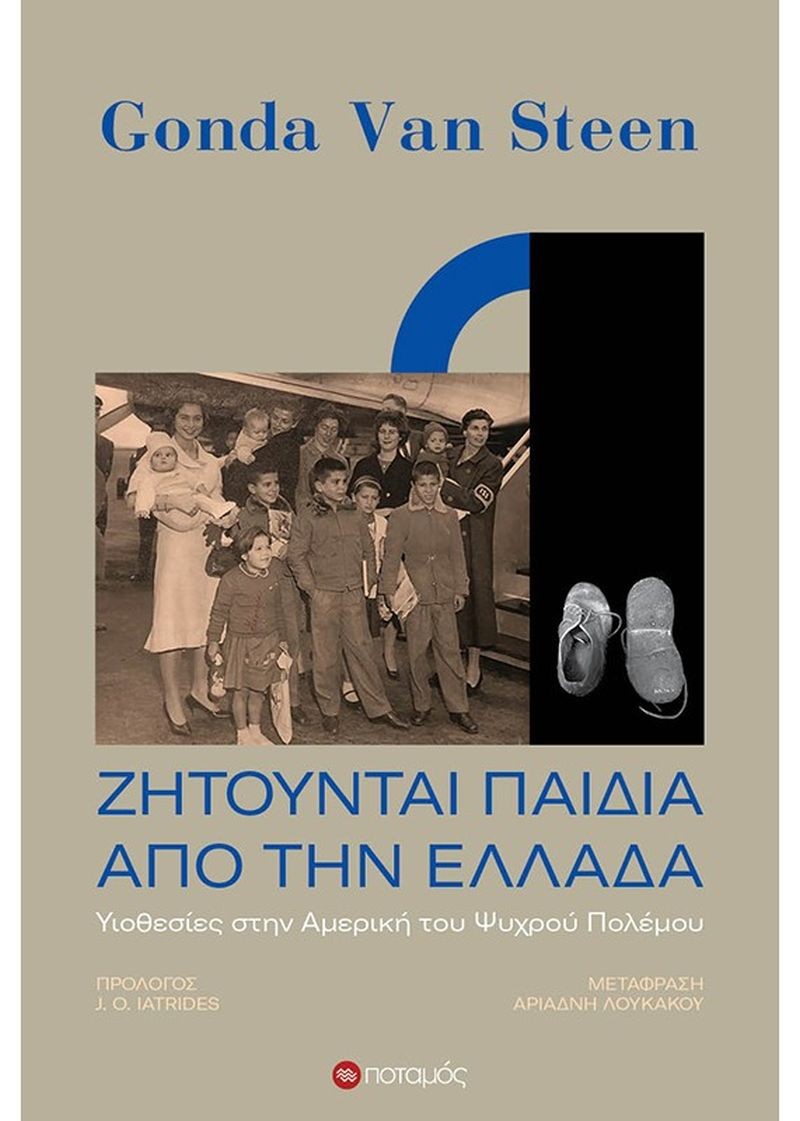
Can you tell us about, talk about this picture?
Yes. This is the cover of the Greek translation of the book. It features a picture where you see about eight children arriving in New York. They’re just stepping off the plane. You see the plane behind them. There are all these children and there are also babies. And the picture consists of a few adults, as well. One in the picture, one woman in the picture dressed in white is princess Sophia of Greece, because, as we know, the queen was involved. And at that moment, princess Sophia is on a visit in New York and she's on the receiving end of the children. Next to her, holding a baby and kind of cuddling the baby, is the then famous actress Jane Russell, who was very involved in international adoptions and adopted a few children herself to great publicity. The idea of celebrity adoptions —and think Angelina Jolie, think Madonna— actually started with the Greek adoptions. So, celebrities want in on this. They want a child, but mainly some use an adoption as a way to reinvigorate their career, as a way to kind of drop publicity for their humanitarian work. So, this is very problematic for a child, to kind of be used as [00:50:00]the newest thing in the life of the celebrity. Not exactly a recipe for a good family life. But in any case, here is Jane Russell holding a baby. She did not adopt a Greek baby. She adopted other babies. And here are representatives of the ISS, the International Social Service, who wear the bracelet on their arms identifying themselves as social workers. And they've just landed. And you can tell that clearly the journalist must have come out, because this is a post picture. And the children are actually very well dressed and they're holding trinkets that they give them on the plane, coloring books and all of that. And they will soon be handed over to their parents.
It's like a publicity op…
It's a publicity, it's a photo op. Τhis is staged as… Τhis is what startles me. Ιn Greece, these adoptions are treated with huge confidentiality, secrecy, and then, on the other hand, they arrive and it's all publicity. And so, the way I learn about many of these adoptions is because the newspapers write about them! Parents show off their child in newspaper articles, pictures, addresses, names, everything. So, the same child that was sent from Greece under absolute secrecy, almost like a state secret —right?— is received with utter publicity. Cameras flashing, reporters, interviews, congressmen come out because they helped with the paperwork! And it becomes this kind of publicity stunt to see these children arrive from Greece. And this is one such picture.
What does the paper say?
Oh, “These children”… They describe how these children are a little unsettled, but then, you know, the parents give them dolls and they give them ice cream. And the kids are so intrigued by the car and the vacuum cleaner and the washing machine and everything that is electric. And so, the children love American breakfast and spaghetti and pancakes. And the children, they often describe how the children, for instance, hoard food. For instance, when there are extra pancakes, the child will stick some in their pocket. And so, the parents have to convince the child that there is no shortage of food and that the food is in the refrigerator and that they can eat anytime they want. But you can see that institutional life has taken its toll on the children. They protect their food and they take leftovers thinking that they'll need them tomorrow! And so, to kind of gain these children's stress, you can kind of tell what barriers you already have to overcome to make this child feel at ease and at home.
It has stayed with me, some testimony of an adoptee that told that the adoptive parents had sent photos in the orphanage in order to match, to have the children that matches. Can you mention that?
Yes. One lawyer had this practice, that if the American family wanted a girl, they needed to send a picture of the mother, so the girl would look like her mother. And if they wanted a boy, they needed to send a picture of the new father, so that the boy would look like his father. In the end, none of that holds. The truth is that makes the parents feel good. The truth is they took any, any next available child. I'm sorry, but this is a little bit… These are the kind of fairytales that come in to make everybody feel good. And the truth is otherwise. There was no matching. There was the next available child and the child actually doesn't look one bit like her mother.
Were there any money involved from the adoptive parents?
Yes. The adoptive parents paid the lawyer, who acts as an intermediary and they pay good money. They pay the equivalent of a year’s salary in American dollars, which in Greece, in the 1950s, there was constant inflation, so the Greek drachma doesn't really hold very well. So, the money that carries its value and stays stable is the American dollars. So, for a lawyer then to be paid for several adoptions in American dollars is some very handsome money. So, we calculate that one lawyer in particular, who really scored the greatest number of adoptions, must have earned the equivalent of half a million American dollars. And you have to multiply that 30 times to come to today's value. So, we are talking about 50 million dollars in a couple of years, one adoption after the other.
So… And there were then donations…
And in addition, the parents are so pleased, that not only do they pay the lawyer and they pay for the clothes and the shoes and the… and also they pay for the maintenance of the child as soon as the official adoption has happened. So, if the child needs an extra two months to be taken care of an institution before it can go on the plane or if it falls sick and it has to wait to go on the plane, the parents already pay for that. And then they give donations, in addition, to the orphanage, you know, so that their child will receive extra good care —which doesn't necessarily reach the child— or they send toys or something like that. None of that necessarily reaches the child. They have no way to control it. One institution built very close connection with the Netherlands. And in the archives we find that the Dutch had understood that with donations you can kind of lubricate this traffic and the Netherlands would be singled out as a favored country for these adoptions from «Μητέρα», actually. And there were 600 of these Greek adoptions to the Netherlands and the Dutch gave three refrigerators and one washing machine, which really swayed the administration that the Dutch were the right people to send children to. But then, how does the child feel about having been given up for the sake of three refrigerators and a washing machine? I find it very painful.
Finally, tell us a little bit about you. How did you end up... We all know, how did you end up of searching like that, but how did you end up, you know, having to do with all this huge…
First of all, I feel a sense of obligation. I feel I have a certain knowledge of Greek, of archives. I discovered this history and I find it a fascinating history, but then I discover the people and all their questions. And so, it can't leave me unaffected. I feel: “Oh my God! I have an opportunity to make something happen, to correct a piece of this history”. And that's incredibly powerful. So, I felt I had to tell the story. And then, alongside I met some people and they know other people and they have searches and they share their documents and they share their pictures and they tell their story and I encourage them to write their story and to speak out. And so, from one thing came another and I feel actually very… They opened up for me and they're very touched by the fact that nobody yet, actually, ever paid attention to them and that this finally made their story come to the forefront and empowered them to speak. They find that very powerful. And in English. That's also important. And so, they empower me and I empower them and they seek out each other, because they feel a sense of kinship with each other, with the people who went through the same thing. And if I may say so, they actually adopted me. So, I adopted their cause, they adopted me and I found out a great honor. They let me in. And they're very protective of their feelings and of their circle, because they feel that people who are not adopted don't really get it. But they adopted me and I find that very special and I feel a sense of obligation. And if I have a public forum in which I can say that, I will promote their cause. I will be their first advocate.
You're a professor.
Yes.
You're a known philhellene also. Have you imagined that you would be caught up in such a big cause?
Not a bit, not a bit. This comes as a surprise to me, but it has energized me in a whole new way. There's… I don't count the hours I spend on this. This just needs to be done. And if I can facilitate something with what I know and what I can connect and what information I've gathered, I have to do it. It's a moral obligation. And… But then, because I'm so committed, I'm also not shy, pointing out that a few other people also have moral obligations: the state to do something, the people who keep the records to give up those records. I feel I can ask that because it's a good cause. It's a good cause and I'm committed to it and I won't spare time and energy. So, let's do this together. This is an opportunity to correct a piece of History that still can be corrected, which isn't always the case with History, and therefore, has to be corrected.
Perfect.
And so, I'm pursuing this, I'm pursuing this. I feel it has to be addressed at a state level, because it was the state who let this happen and it's the state who has an obligation to take these people back. And whenever I hear all this talk about το δημογραφικό πρόβλημα και γονιμοποίηση και όλα αυτά, κάπως λέω: “Yes, but you let 4,000 people go. This is a huge human capital. Instead of encouraging women to have more babies, take care of the ones we already have, right? Welcome them back”.
Okay. Lastly, we'll need, just for the record, to talk us a little bit about yourself, who are you and what do you do apart from all this huge work that you're doing.
I am, Gonda Van Steen. I'm Flemish Belgian. My mother tongue is actually Flemish. So, actually, that gives me the advantage of being able to relate to the Dutch adoptees as well. That's great. I've done a lot of wo[01:00:00]rk in Greece, about Greece, about Greek theater. I've actually been with the Greek language since I was 12. I love it. I started with ancient Greek. Now I'm much more interested in Modern Greek. I teach at King's College, London, where I also hold the Koraes Chair. I'm very happy, actually. After the years of working in the US, I'm very happy to be in London, which also puts me in closer contact with Greece, and that's very important to me. So, I try to come regularly. I have work to do, I have cases to solve and I'm just really passionate about this cause and what I can contribute.
What drove you close to Greece?
I was always fascinated. I started with the fascination of ancient Greece. And then, whenever I discovered modern Greece, I realized that all these people, who have been studying classics and the classical language only, have missed the history. And so, I felt, you know, there are enough people doing classics. They don't need one more. And I became completely interested in modern Greece, step by step, more and more deeply. I also lived here at some point for four years. I had a job here. I lived and worked in. I actually lived in Kato Patisia. So, I understand something about local neighborhoods. People always ask me where I'm from. You know, I don't look one bit Greek. They ask me where I'm from. And, that's an important question. And here is maybe a good point to end: The first question that the Greeks always ask of foreigners and of other Greeks είναι: «Από πού είστε;» So, if it's so important to know where you're from and this is really the fundamental question that drives every single conversation with any Greek, wherever, then it's important for these 4,000 people also to know «Από πού είστε;». And that's the answer we need to give them and everything that comes with it. So, on that note, I wanna leave that message.
Thank you very much for your interview.
Thank you, thank you. Εγώ σας ευχαριστώ.
Photos
Summary
Περίπου 4000 Ελληνόπουλα δόθηκαν προς υιοθεσία σε χωρες του εξωτερικού και κυρίως στις ΗΠΑ, κατά τη διάρκεια του Ψυχρού Πολέμου. Υιοθεσίες που έγιναν με γρήγορες, εκβιαστικές κι αδιαφανείς διαδικασίες, χωρίς κανέναν έλεγχο των θετών οικογενειών, με υψηλό αντίτιμο και πολλές φορές, με πολιτικά κριτήρια, ήρθαν στο φως μετά από μακροχρόνια έρευνα της ακαδημαϊκού και φιλέλληνα Gonda Van Steen.
Narrators
Gonda Aline Hector Van Steen
Field Reporters
Μάγια Φιλιπποπούλου
Interview Date
22/11/2021
Duration
62'